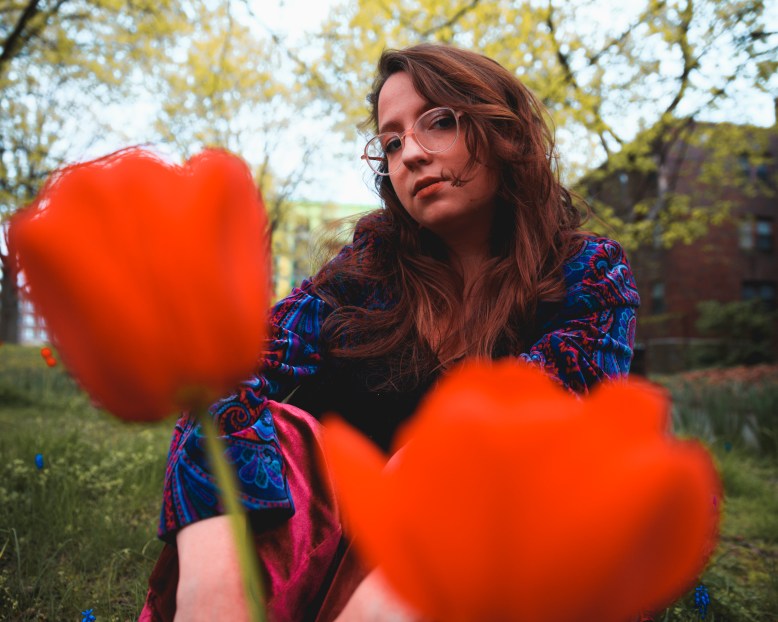
Tiny Talks is an interview series with Tiny Spoon’s talented contributors. This week we spoke with Shloka Shankar from Issue 9, Cut/Copy/Paste: The Remix! Find their poem, “what to say” in our ninth issue!
Tiny Spoon: What was your process for engaging with the Cut/Copy/Paste Remix? How did you choose what to keep or what to omit?
Shloka: I read through the entire issue and opened a notepad to the side. As I was reading, I copied phrases, words, and lines into the notepad. Then, I remixed my selection into a poem by adding and deleting, sometimes altering the tense, et cetera. It’s an intuitive process, really, and I stop when the poem speaks to me and begins to “sound” like something I would have written. Found poetry works only if the individual sources are elevated/altered to create something new, exciting, and different.
Tiny Spoon: What kindles your creativity?
Shloka: I love making abstract collages and creating visual poems from there. A single word or phrase I read in another poem can also spark something in my own head. It’s about paying attention and noting down the most innocuous things that might trigger the muse later on. Being playful and experimental alleviates the pressure to “get something done.”
Tiny Spoon: Are there any natural entities that move your work?
Shloka: We’d love insight into your creative process. Could you share what it is like for you, either with your work that appears in Tiny Spoon or in general?
Tiny Spoon: Do you have any current or future projects that you are working on that you would like to share?
Shloka: I am the Founding Editor of Yavanika Press, an indie publisher of eBooks, and we have a whole bunch of new titles coming out in September.
Tiny Spoon: Is there anything else you would like others to know about you, your creations, or beyond?
Tiny Talks is an interview series with Tiny Spoon’s talented contributors. This week we spoke with nat raum from Issue 9, Cut/Copy/Paste: The Remix! Find their poem “cytotopography” in our ninth issue!
Tiny Spoon: What was your process for engaging with the Cut/Copy/Paste Remix? How did you choose what to keep or what to omit?
nat: Having worked in the past with erasure fragments, I found a lot to draw from in the issue. I started by reading the issue and marking pieces I found interesting. Traditional erasure isn’t all about having interesting words; it’s also about having enough connective tissue to make them work. But since I was reconstructing fragments from multiple pieces into one piece, interest definitely played a large part in my selections, as did euphony.
Tiny Spoon: What kindles your creativity?
nat: I consider myself an artist before I consider myself a writer in that most of my writing practices don’t differ much from my art practice. I took a class in early undergrad about using “any medium necessary” to accomplish something creatively, and treat my poetry as a medium within that practice. So my creativity comes out in many ways, and is mostly kindled by my lived experience. Most of my work starts with something I observed, often woven into a memory.
Tiny Spoon: Are there any artists, heroines, idols & friends that you look up to?
nat: My photographic idol is absolutely Nan Goldin. I’ve always really related to her practice of documenting the people and places around her every day and find myself emulating her in some way or other basically always. I definitely look up to many of my fellow editors and artists as well, considering many people who started as collaborators to be close friends now. To name just a few wonderful creatives and friends, check out the artwork of Sarah Eckstine, Hyacinth Schukis, and Nick Norman, and the writing of Rachael Crosbie, Charlie D’Aniello Trigueros, Clementine Williams, and Andrew Daugherty. I also want to give a special shoutout to Kelsey Sucena, who’s both an artist and a writer, and someone whose work I recently published that I admire.
Tiny Spoon: Are there any natural entities that move your work?
nat: I would say not in any specific way, beyond experiencing nature through visiting my parents’ house in the forests of Baltimore County and my extended family in Appalachia. The other thing I would say is that often, my imagery begins with (or touches) the way light is behaving, and I think that comes naturally to me as someone who studied photography for my undergraduate degree.
Tiny Spoon: We’d love insight into your creative process. Could you share what it is like for you, either with your work that appears in Tiny Spoon or in general?
nat: I’m somewhat of an obsessive maker. I typically have an idea for something and go right for it, stopping very little along the way. It’s definitely how I’ve been able to maintain such a consistent practice over time, but it does lead to a lot of things being tabled for later and never returned to. That being said, a lot of my recent work has involved explorations of the past that allowed me to return to those abandoned WIPs—childhood religious trauma in my chapbook ‘preparatory school for the end of the world’ (2021), substance use and femininity in my early 20s in my hybrid memoir ‘you stupid slut’ (2022), and objects as agents for memory in my chapbook ‘specter dust’ (2022). A professor of mine told me the past is unbelievably rich for inspiration through memory, and I definitely agree.
Tiny Spoon: Do you have any current or future projects that you are working on that you would like to share?
nat: I tend to have a lot going at once, but the project I’m working on most actively right now is a full deep dive into the idea of the digital archive. I’m searching my old social media posts and backup-drive documents and pictures from as far back as 2009, as well as working on erasures of novels I read as a teen. The final result of each work is a hybrid piece that combines a piece of writing with a digital collage. My work tends to be personal, but this is a very different kind of personal for me and it’s really exciting.
Tiny Spoon: What book, artwork, music, etc., would you recommend to others?
nat: Though I read a lot of great work and consume a lot of incredible art as an editor, I consequently rarely get to talk about how much I love music. I love ambient music—and really beyond just lo-fi, though I love lo-fi too. I’m constantly discovering new ambient artists, but my favorites consistently come from Jonny Nash, Suzanne Kraft, Virginia Aveline, and Suso Saiz. I’m also a huge fan of Glass Animals and Fall Out boy for their lyrics.
Tiny Spoon: Where can people learn more about what you do?
nat: My website is viewable at natraum.com, and I’m on Twitter and Instagram (@gr8earlofhell).
Tiny Talks is an interview series with Tiny Spoon’s talented contributors. This week we spoke with Ray Frost from Issue 9, Cut/Copy/Paste: The Remix! Find their collage comic, “The Intimacies We Have Shared” in our ninth issue!
Tiny Spoon: What was your process for engaging with the Cut/Copy/Paste Remix? How did you choose what to keep or what to omit?
Ray: I read through the whole issue once just to experience it. Then I reread it a few days later and cut out all of the words, phrases, and images that jumped out at me. The next day I looked at everything I cut out and played with arranging them until I found a poem that I felt told a story.
Tiny Spoon: What kindles your creativity?
Ray: Nature, music, and things I see out riding my bike.
Tiny Spoon: Are there any artists, heroines, idols & friends that you look up to?
Ray: I look up to a lot of the other artists who also work out of the Reno Generator. It’s an amazing community with so much talent. I also look up to Ashley Anderson (@hiddenstash.art), Pine Bones, and Hyena Hell.
Tiny Spoon: Are there any natural entities that move your work?
Ray: The moon is a huge symbol in both my life and my work. My work is also heavily influenced by the landscape of the Nevada high desert.
Tiny Spoon: We’d love insight into your creative process. Could you share what it is like for you, either with your work that appears in Tiny Spoon or in general?
Ray: Most of my work starts with a note in my phone and a bunch of reference photos on my laptop. I make sketches until I find an image that speaks to me and go from there.
Tiny Spoon: Do you have any current or future projects that you are working on that you would like to share?
Ray: I’m currently working on finishing up issue 10 of my zine series How Did This Happen??? which follows the adventures of a reanimated roadkill coyote
Tiny Spoon: What book, artwork, music, etc., would you recommend to others?
Ray:Coyote Doggirl by Lisa Hanawalt.
Tiny Spoon: Is there anything else you would like others to know about you, your creations, or beyond?
Ray: My art is a huge part of how I cope with my depression and I hope my work is a bright spot for other people as well.
Tiny Spoon: Where can people learn more about what you do?
Tiny Talks is an interview series with Tiny Spoon’s talented contributors. This week we spoke with Crystal Bowden from Issue 8, Cut/Copy/Paste: The Original! Read her poem, “Dream State” in our eighth issue!
Tiny Spoon: What kindles your creativity?
Crystal: Giving myself the space and time to sit with ideas is essential for my creative practice. Also, reading is a constant source for me. Books live inside me, changing how I think and what I know. That inevitably bleeds its way into my work.
Poetry and collage are how I express myself and draw on my relationship with others in the most collective sense. In this way, each poem or collage I create tells a different story through interiority. I hope people find their own stories buried within the layers.
Tiny Spoon: Are there any artists/ heroines/ idols/ friends that you look up to?
Crystal: Too many to list for sure! Honestly, I find women ridiculously inspirational. Every time I see another woman doing something amazing, whether it’s a creative endeavor or not, I feel uplifted. I feel stronger. We all have so much potential within us that at any given time is being suppressed, both externally and internally; all I can think is BRAVO. Get it. We’ve got this.
Time
Tiny Spoon: Are there any natural entities that move your work?
Crystal: As humans, everything we are is rooted in the natural world, so I find that connectedness essential to my work. I love to make a study of nature. I’m an avid bird watcher – my yard is full of feeders! Peterson Field Guides and the App Seek are great for identifying things I cannot put a name to.
Tiny Spoon: We love insight into the creative process. Could you share what it is like for you, either with your work that appears in Tiny Spoon or in general?
Crystal: I’m a pen and paper person when it comes to writing. And I rarely write poems at the start, even though poems are all I write. Instead, I like to get my ideas and thoughts down loosely on the page before I ever try to turn them into something more structured and coherent. These usually look like lists more than anything else. Then I’ll take those ideas and start arranging and structuring them into a poem. Only after that will I move the poem from my writer’s notebook into a digital document for revisions. It’s best if I take some time between the original writing and revisions, so I lose some of my sentimental attachment to the original and view it more objectively.
When I create visual arts, I hardly ever go into a piece knowing my overarching goals or what will happen in the artwork. Instead, the process is intuitive and generally driven by mood and whatever is currently sitting heavily in my brain. Those inform my decisions, whether the color palette, imagery, or composition. I try not to overthink these things and let myself flow.
Simple Rhythm
Tiny Spoon: Do you have any current or future projects that you are working on that you would like to share?
Crystal: Currently, I’m working on a manuscript for my first poetry chapbook titled, Before the Exhale. The title comes from a line in my poem, Middle Spaces, about all the ways we live in between one thing and the next. These show up in my work in numbered and varied ways, and you’ll see this throughout Before the Exhale.
Tiny Spoon: What book, artwork, music, etc., would you recommend to others?
Crystal: For other poets, I highly recommend the book, Glitter in the Blood: A Poet’s Manifesto for Better, Braver Writing, by Mindi Nettifee. For those who love reading poetry, read Lord of the Butterflies, by Andrea Gibson.
Mood
Tiny Spoon: Is there anything else you would like others to know about you, your creations, or beyond?
Crystal: I regularly publish in magazines! You can keep up with new individual publications by following me on social media. You’ll find my work included in upcoming issues from The Spring City Journal and Pile Press.
Tiny Spoon: Where can people learn more about what you do?
Tiny Talks is an interview series with Tiny Spoon’s talented contributors. This week we spoke with Oormila Vijayakrishnan Prahlad from Issue 8, Cut/Copy/Paste: The Original! Read her poem, “Death Dream in Purple” in our eighth issue!
Tiny Spoon: What kindles your creativity?
Oormila: Everyday things! I believe there is magic in the commonplace. I see my art and poetry as documentations of my daily experiences — conversations I have with my children, the people I meet, sights and scenes I encounter on my walks, photos I take.
Tiny Spoon: Are there any artists/ heroines/ idols/ friends that you look up to?
Oormila: I can think of so many! Off the top of my head, I look up to Carolynn Kingyens for her luminous poetry that brims with tenderness and humanity, Zaina Ghani for her wonderfully imagistic works, Nina Bennett, Beate Sigriddaughter, Alexis Rhone Fancher, Sneha Subramanium Kanta, and Mandira Pattnaik’s for her lyrical flash fiction. Idols I admire — my friend Sandhya Devanathan. She is my role model.
Tiny Spoon: Are there any natural entities that move your work?
Oormila: I live in a green and leafy suburb of Sydney. I get visits from all kinds of lovely wild spirits: bunnies, possums, magpies, bush turkeys, cockatoos, and lorikeets to name a few. I have published several series of mixed-media artworks and poems inspired by these beautiful creatures. My studio overlooks a lovely garden and during the lockdown, the wildlife was pretty much my social life. They figure prominently in a lot of my work.
Tiny Spoon: We love insight into the creative process. Could you share what it is like for you, either with your work that appears in Tiny Spoon or in general?
Oormila: I have several projects going on at any given point in time, and I keep switching among them. I like to work in an organized space which is easy when I am writing poetry. It’s the painting that gets messy and I find myself getting distracted and cleaning up in the middle of work very often! I always carry a sketch book and a notepad. In the pre-Covid days, a lot of my poetry drafts were written either on train commutes or while waiting to pick my kids up from school.
Tiny Spoon: Do you have any current or future projects that you are working on that you would like to share?
Oormila: I am working on two micro-chapbooks. Both my parents have milestone birthdays coming up this year. My mum turns 70 and dad turns 75 and I want to surprise them with two collections of poems dedicated to both! I also have plans to put together a full-length poetry manuscript at some point.
Tiny Spoon: What book, artwork, music, etc., would you recommend to others?
Oormila: Carolynn Kingyens’ books Before the Big Bang Makes a Sound, and Coupling. I am a huge fan of Gaia Rajan’s writing, and I loved her chapbook Moth Funerals. I would also recommend Phillip Hall’s brilliant collection of poems, Cactus, which is a heart-breaking exploration of depression and what it is like to live with it. I also recommend all Shankari Chandran’s books: Song of the Sun God, The Barrier, and her latest novel, Chai Time at Cinnamon Gardens.
Tiny Spoon: Is there anything else you would like others to know about you, your creations, or beyond?
Oormila: Besides writing poetry and painting, I play improv piano — some Metallica, Pink Floyd, Guns and Roses. I have a huge collection of odds and ends in my studio, and I use some crazy materials in my mixed media works sometimes. Recently, I made “cat wool” from the hair from my cat’s brush. It made for the most delicate silver wool, and I added it as accents to a few winter-themed mixed media landscapes. It looked great!
Tiny Spoon: Where can people learn more about what you do?
Tiny Talks is an interview series with Tiny Spoon’s talented contributors. This week we spoke with Shannon Gardner from Issue 8, Cut/Copy/Paste: The Original! Find her artwork, “Mother Monster,” “Nighttime Hue,” “A Joke to You,” and “Don’t Stop or We’ll Die” in our eighth issue!
Tiny Spoon: What kindles your creativity?
Shannon: Watching horror movies and studying paranormal kindles my creativity. The spontaneous process of nature inspires me to explore Earth’s unfound beauty and imitate its natural imperfections. I enjoy creating art depicting paranormal elements and iconography.
Ol Poogley-Pie, Collage, 2021
Tiny Spoon: Are there any artists/ heroines/ idols/ friends that you look up to?
Shannon: I am inspired by German Expressionism artists like: Edvard Munch, and Tim Burton. Surrealist artists like; Picasso and Claude Cahun. Expressionists like Egon Schiele and Contemporaries like Polka-Dot artist Yayoi Kusama. My process is similar to artists who encourage exploring the taboo and Surrealist/Psychic Automatism or the act of creating art disconnected from consciousness. My work focuses on exploring the unconscious mind as a way of creating art, resulting in innate, dream-like imagery.
The Arm, Watercolor and Ink on Paper, 2021
Tiny Spoon: Are there any natural entities that move your work?
Shannon: Supernatural entities continue to inspire my work, paranormal phenomenon. The surrealist unbridled reign to the consciousness is how I approach art making. I have an ambition to spend my life studying the occult and paranormal. I enjoy projects that involve a proactive and sustainable message.
Siren Song, Watercolor and Ink on Paper, 2021
Tiny Spoon: We love insight into the creative process. Could you share what it is like for you, either with your work that appears in Tiny Spoon or in general?
Shannon: I enjoy line and dot work, stippling and cross-hatching, clusters of value implying crisp texture and depth, giving the illusion of change through time. My serendipitous approach to watercolor and ink creates a profound contrasting aura with my surrealist illustrations. Through my process, I attempt to disassociate my hand from my consciousness, work directly from instinct. As a result, I have found my best work is created when I’m not thinking.
I often draw on paper with an ink pen an interesting idea, inspire in the spur of the moment. I enjoy creating multiple line pieces over a relatively short period of time. The pieces sit unfinished until I find enough time where I can devote myself to paint all the pieces with watercolor. This makes a cohesive palette of color throughout multiple pieces.
Mommy’s Girl, Watercolor and Ink on Paper, 2021
Shannon: I usually paint when I work in my studio. I enjoy painting from a used palate, working off pigment from previous sessions to avoid wasting materials. I find working on paintings in the mornings while working on drawings at night yields the best results. I am currently working more in collage, assemblage, and sculpture. I have always worked in 2D with an emphasis on the outline, so when branching out to 3D I am enjoying playing with the minimalist relationship between figurative and abstract work.
I have much confidence in my work; as a result, I have been featured in dozens of publications worldwide. I understand that if you apply yourself the worst outcome is a formal rejection with appreciation of your submission. I have the ability to create a plethora of work in order to meet deadlines and ensure quality work.
David, Watercolor and Ink on Paper, 2020
Tiny Spoon: Do you have any current or future projects that you are working on that you would like to share?
Shannon: I’m currently working with Collage-Lab where I’ll be teaching a workshop on how to incorporate hand-drawn illustrations and collage. There I will explain Surrealist Automatism and how to think of collage making as a spontaneous process.
I am also involved with an online Zine called Continue The Voice. Released quarterly as a platform to share art and voices of all kinds. My original illustrations are featured throughout and exclusively on the Coorie Moments pages.
All-Star, Watercolor and Ink on Paper, 2021
Tiny Spoon: What book, artwork, music, etc., would you recommend to others?
Shannon: A book that I’m currently into is called, Begone Satan: A Soul Stirring Account of Diabolical Possession in Iowa, a 19th century exorcism of a woman local to where I am from. For inspiration I would suggest researching and finding books from your childhood that encouraged you to read as a child or that inspired you in any way. Revisiting those stories may help or unlock things that can benefit you in the future.
Optometrists, Watercolor and Ink on Paper, 2021
Tiny Spoon: Is there anything else you would like others to know about you, your creations, or beyond?
Shannon: What I value most in my work is honesty and confidence. As an artist I strive not to be a perfectionist, I seek to make mistakes. Appreciating the process of nature, death, and decay I practice the Asian technique of Wabi Sabi; the aesthetic within imperfections. I strive to explore the unearthed beauty and imitate the natural imperfections. I live for crooked lines and brushstrokes. The human journey is not a straight line but a labyrinth of twists and turns, an imperfect spiral with one way in and out. Through my work I hope to embody those imperfections. My goal is to show the audience the importance of appreciating people, emotions, achievements and pain. I strive to evoke a haunted aura of remembrance that death and decay reflects the evident future of life. All parts of Earth’s cycle should be celebrated, not overlooked or forgotten.
Flower Child, Watercolor and Ink on Paper, 2021
Tiny Spoon: Where can people learn more about what you do?
Our 8th Issue is packed full of exciting artists and writers! Our blog is an extension of the issue so we can share even more experimental, beautiful work with our readers! This piece is also in print.
Looking In
Process Note: Establishing Roots first created in 2016 inspired the later series of altered atlases What Is and What Was. Establishing Roots uses a world atlas and as each page turns one house shape is hand-cut from the page.
What Is and What Was from 2018 includes four wooden stools circling a table inviting viewers to sit down and view four altered North American and Canadian atlases. As the pages turn houses are removed from the page showing the changing landscape both through the altering of cut-outs and the found object of the atlas continuing to outdate itself. Looking In is one of the featured atlases in this piece.
Establishing Roots
Establishing Roots
Bio: Jackie Partridge is a mixed media artist working with handmade paper, recycled maps and objects living in Wellesley, ON, Canada.
Tiny Talks is an interview series with Tiny Spoon’s talented contributors. This week we spoke with Alex Wasalinko from Issue 8, Cut/Copy/Paste: The Original! Read her poem, “Apocalypse Next Tuesday” in our eighth issue!
Tiny Spoon: What kindles your creativity?
Alex: I love finding an image, a word, a piece of art, even a corny tabloid heading that moves me to think How can I include this in my work? It was never intentional, but found language and objects are often the entryway to my flow. So much of my writing and art begins with repurposing and repositioning the pieces of inspiration I find into new contexts. Being out in the world and taking lots of walks gives me so much material–either physical things I can interweave into a bigger project or some fresh perspective to get everything down on paper. Creativity for me comes when I gather these pieces together, kind of like a treasure hunt.
Tiny Spoon: Are there any artists/ heroines/ idols/ friends that you look up to?
Alex: One of my all-time favorite writers is Sarah Ruhl. I read Melancholy Play early in the pandemic and purposefully took extra time to move through it because I never wanted it to end. I’m also a giant fan of Adrienne Rich’s poetry, and she has really shaped how I approach writing. In terms of the Big Figures who influence me, Ruhl and Rich make the top of the list. I’m wildly fortunate to have circles of friends who are some of the most brilliant people that I’ve ever met, in their art, the way they move through the world, their dedication, their care. Honestly, I look up to each of them daily.
Tiny Spoon: Are there any natural entities that move your work?
Alex: The first thing that comes to mind is flowers. So much of my work circles back to flowers. They’re steadfast. And I know it’s not “natural” in the same way flowers are, but I think I would categorize a city as a natural entity here, too. I live in Philadelphia at the moment and I’ve written more in the relatively short time I’ve lived here than maybe ever before, and so much of it comes back to moments, sights, sounds, all the little entities that have moved me around the city. It’s the street art and graffiti, the nonstop construction that pops up overnight that reshapes the landscape, even commuting on the El train from 30th Street–it got to a point that I was writing so much either while waiting for the train or on it that my phone began to suggest I open my notes app pretty consistently around the time I commute. Not all the sensory elements that I encounter appear in my writing, but there’s something electric about it that gets me into a flow.
Tiny Spoon: We love insight into the creative process. Could you share what it is like for you, either with your work that appears in Tiny Spoon or in general?
Alex: My piece that appears in Issue 8, “Apocalypse Next Tuesday ” came about pretty differently compared to my collages, poetry, or hybrid work. It began from a devising writing group I joined in the spring of 2021 with some former college classmates and mutual friends. We always kicked off our writing sessions with idea brainstorms and word association games to generate some raw, fresh material. “Apocalypse Next Tuesday” was first drafted as an impossible stage direction activity–where the laws of nature cannot limit what happens on the stage–using some of the elements from my list of items from the collaborative brainstorms. Then, like almost all of my pieces, I let it rest until I was ready to make it into something fuller and (hopefully) more refined. At the core though, the process had a similar start, of taking a small occurrence and thinking “Okay, now how can I build something full from this phrase?”
Tiny Spoon: Do you have any current or future projects that you are working on that you would like to share?
Alex: I’ve been itching to get back into my Internet Oddity zine series, which takes the very mysterious yet lyrical Google search results for robo call numbers or exact searches for unusual word pairings. It’s a trippy time, but I really love extracting the weirdness of it all. Next time you get a random spam call, I highly recommend exact searching the number to see what pops up.
In terms of publications, I’m revising some works to send out for some open calls. Ideally, before the end of 2022, I want to have some kind of manuscript ready to be sent out. Fingers crossed. I have a poem appearing in Perennial Press’s anthology force / fields, which I’m super excited about!
Tiny Spoon: What book, artwork, music, etc., would you recommend to others?
Alex: I recently revisited Emily St. John Mandel’s Station Eleven, and highly recommend, especially if you watched the show. I find the book to be more hopeful, but then again I didn’t get past two episodes of the series so maybe I need to be proved wrong here lol.
If music is your speed, I’ve been on a very big Dr. Dog kick lately, and always recommend them if you’re looking for some fun beats and witty lyrics. They’re masters of their craft.
Art–I always recommend my favorite artist Phoebe Anna Traquair’s The Progress of a Soul series. They’re massive silk embroidered tapestries that are simply breathtaking. Every few months I return to them for some inspiration.
Tiny Spoon: Is there anything else you would like others to know about you, your creations, or beyond?
Alex: I don’t think I formally gave my little artist statement introduction so: I’m a poet by way of training, but in practice I consider myself a more interdisciplinary and self-taught writer-artist. Much of my work begins as an experiment. Sometimes it takes off and sticks with me, a lot of times it doesn’t, and I’ve learned that’s okay. I’m happy with how my work and my approach to creating evolved over the past couple of years. It feels really wonderful to be making and to have the space to do so, a sentiment I acknowledge regularly.
Tiny Spoon: Where can people learn more about what you do?
Alex: At the moment only my instagram. It’s a dumping ground for anything I’m working on and some process reflections, announcements, etc. Maybe in 2022 I’ll finally launch a website, or a Patreon? The only way you’d know if that will happen is if you follow my IG!
Our 8th Issue is packed full of exciting artists and writers! Our blog is an extension of the issue so we can share even more experimental, beautiful work with our readers!
Ghost
The ghost always appeared when Noel was in the shower. A pervert ghost, she thought. How lucky. The ghost itself wasn’t a surprise. The house—a four-story Queen Anne that smelled like the Boer War and had been turned into flats—was full of them. For the most part, they stuck to the usual hijinks and tricks. They appeared when you didn’t expect them, rearranged the furniture, banged on the pipes, messed with the lights. Occasionally, they cried.
Candace, in apartment one, got a kid ghost. Scrappy thing with a bowl cut and a sailor suit. He mostly hung out under her kitchen table, like a dog, and scratched at her feet. Noel once found his tiny navy necktie near the basement washing machine. Candace was relieved when Noel returned it—the ghost, she said, had been looking for it.
A lady ghost lived upstairs with Deb in apartment four. Unlike the others in the house, Deb’s ghost was modern. Sixties era. Big-eyed and barefoot. Janis Joplin hair. Pouty. Noel had only seen her a couple of times: once in the backyard, and a second time near the mail slot. The tenants all agreed the crying they heard was Deb’s ghost, though Noel always wondered if it was in fact just Deb, sobbing over her latest break-up, or the sight of her Roman nose.
Jun lived down the hall from Noel in apartment two. A Masters student, he was into robotics, cycling and potted plants. Cat ghost. Every Monday, Jun left a fresh can of tuna outside his door. Noel noted, it was sometimes empty by the end of the week.
Apartment five was vacant, but there were ghosts there too.
Noel kicked off her running sneakers, chucked her socks in the laundry and stripped out of her gear. 31:13. New personal best. She cranked the tap in the tub, waited for it to get hot, lit a candle, and turned on the shower. She liked the steam. The way it cleaned her pores, rid her body of the city smells that lingered on her skin: pigeon shit, sauerkraut, Saturday night, the dead lilacs and dumpsters.
Just as she went to rinse the shampoo from her hair, there he was. Pervert ghost. Six foot-threeish, hipster beard, fucked up ears—the kind sported by kick boxers and wrestlers. This was the third time this week. Go away, she hollered, elbowing the shower curtain. Do something useful like make me a sandwich. Take out my trash! Fix the little screw that keeps coming off the radiator. Fuck.
Noel finished rinsing, turned off the water, climbed out of the claw-foot tub. Was that an impression on the plush bath mat? Size eleven? Twelve? Her imagination. There was only one print. She smiled. My pervert ghost has a peg leg. A pirate. She towel dried. Went to bed.
A week passed before pervert ghost reappeared. Noel was at Candace’s with the rest of the tenants for their monthly potluck. Jun had brought a seafood casserole and she hoped he’s hadn’t used the hallway tuna. Candace made salad. Deb brought KFC. It was Noel’s turn to bring dessert and she’d stopped at a bakery on the lower eastside to buy a six-pack of fancy donuts. For fun, she bought a sprinkled one for Candace’s ghost.
“Anyone got news?” Deb asked, on her third drumstick.
“My girlfriend’s coming to visit,” Jun replied.
“From China? Ooh,” Candace teased, making a kissy face. “And what about you, Noel? Seeing anyone lately? Any Lumberjacks or Cross-fitters we should know about so we don’t kick ‘em out of the building?”
“Nada,” Noel smirked, licking the icing from a coconut donut. She was still hopeful she and Todd would get back together after his residency. Just wait ‘til he saw her legs.
“By the way,” Deb said. “Landlord was in this morning. He finally fixed the lint trap.”
“It’s about time,” Candace sighed.
Noel hadn’t seen him. Must have come during her run.
Jun said, “I’d given up and was using the campus Laundromat.”
“Alright neighbors.” Noel stood. “Gotta go. I have a massage in…” she paused to check her watch. “Twenty minutes.”
“Have fun!” Deb called.
“Want your donut?” Candace asked, plucking a sprinkle from the top.
“I’m good.” Noel waved, and walked out the door.
After her massage, Noel wanted to take a shower. She hated the feeling of oil along her hairline. But the spa was out of hot water. Something about the construction site next door. Noel wrapped her hair in a bun and walked home.
No ghosts greeted her. Only flyers in the hall and Jun’s bike. She climbed the stairs, opened the door to her apartment, and dumped her purse in the front entry. She found sprinkles in the living room. Maybe pervert ghost and kid ghost have swapped units. Candace has bigger boobs and Noel could use a more youthful vibe. The massage therapist told Noel her skin was starting to sag and sent her home with hyaluronic acid.
Noel tossed her sweater on the radiator. Finally. The Landlord had fixed the loose screw. She grabbed a towel from the linen closet, went to the bathroom and turned on the fan. Fuck a shower, she thought. I’m having a bath.
She filled the tub, added bubble bath and slipped into the water. Within a few minutes, pervert ghost was there, face hovering inches from the shower curtain marred by the steam and the curtain’s Paris motif. Now what? She thought. Do something other than just watch. Like get me a glass of wine! There’s Pinot Grigio in the fridge. Noel laughed, plugged her nose and dunked her head under the water.
When she resurfaced, pervert ghost was gone. She threw on her robe and went to her bedroom. An amputee with cauliflower ears stood in her doorway. A man of size. She could smell him. Cat food, donuts, and sweat. He held up a glass of wine and winked.
Bio: Ali Bryan lives in the foothills of the Canadian Rockies, where she explores the what-ifs, the wtfs and the wait-a-minutes of every day.
Tiny Talks is an interview series with Tiny Spoon’s talented contributors. This week we spoke with Ali Bryan from Issue 8, Cut/Copy/Paste: The Original! Read her short story, “Sweet Caroline” in our eighth issue and her other stories are posted in our Monday Features!
The Hill by Ali Bryan
Tiny Spoon: What kindles your creativity?
Ali: Exploring the what-ifs, the wtfs and the wait-a-minutes of every day.
Tiny Spoon: Are there any artists/ heroines/ idols/ friends that you look up to?
Ali: Jean Smith, Pamma FitzGerald, Miriam Toews, Meg Wolitzer, Wes Anderson, Shia LaBeouf, Seth Rogen, Mike White, Jennifer Coolidge, ABBA, Missy Elliott…
Tiny Spoon: Are there any natural entities that move your work?
Ali: All of it. I grew up on the Atlantic Ocean and currently live in the foothills of the Rocky Mountains. But stars, deer, rabbits, mountains and water figure most prominently in my work.
“Alberta captured under crippling smoke from neighbour BC wildfires”
Tiny Spoon: We love insight into the creative process. Could you share what it is like for you, either with your work that appears in Tiny Spoon or in general?
Ali: My creative process is a blend of intuition and craft and varies from genre to genre, project to project. I love the raw grit of a first draft and the underrated magic of revision. In Sweet Caroline, I enjoyed playing with the juxtaposition of an iconic feel-good song matched with the macabre, messy and often dangerous work of paramedics.
Tiny Spoon: Do you have any current or future projects that you are working on that you would like to share?
Ali: I am currently finishing the edits for my next book of fiction, The Crow Valley Karaoke Championships, which is forthcoming in 2023.
“a crude painting I made last year”
Tiny Spoon: What book, artwork, music, etc., would you recommend to others?
Ali:Lookout: Love, Solitude and Searching for Wildfire in the Boreal Forest is a stunning memoir. Ceramic artist, Pamma FitzGerald’s Left Behindclay installation. Jack Bishop’s paintings, which explore car-culture, consumerism, commercial space and urban sprawl. The Royal Tennanbaums (film), White Lotus (TV). ABBA Gold, NOFX’s Punk in Drublic, the music of David Francey.
Tiny Spoon: Is there anything else you would like others to know about you, your creations, or beyond?
Ali: I was a certified Personal Trainer and worked in marketing and communications before turning to writing full time. I am currently serving as the Edna Staebler Writer-in-Residence at Wilfrid Laurier University.
“sketch of Gary Drayton (sketching the cast of The Curse of Oak Island)“
Tiny Spoon: Where can people learn more about what you do?